

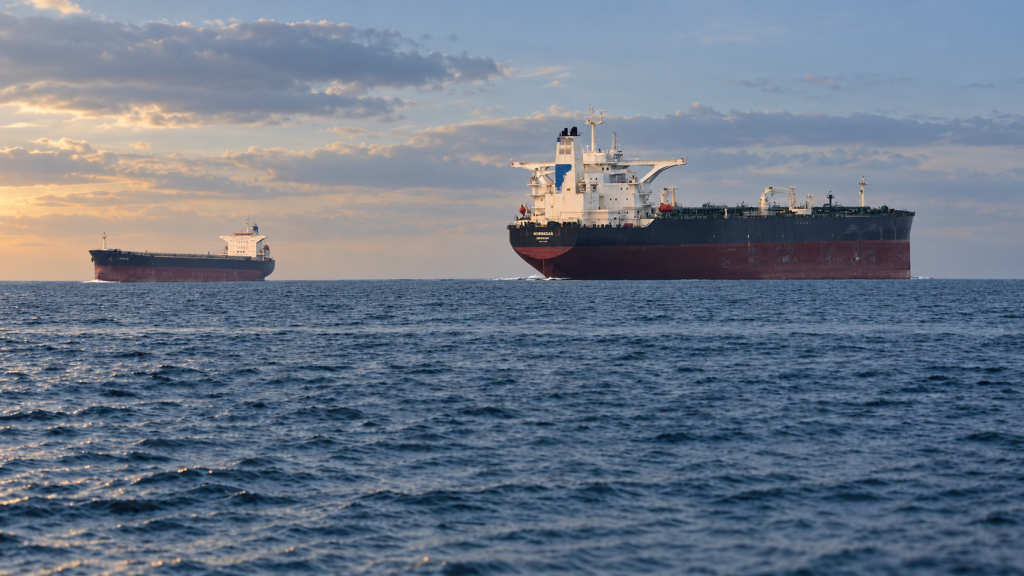
On 9 September 2026, just seven commercial vessels transited the Strait of Hormuz – down from a pre-crisis baseline of more than one hundred per day. Reuters ship-tracking data published on 10 September 2026 confirmed what the market has known for weeks: the waterway through which roughly a fifth of global petroleum once flowed is, for practical purposes, closed to ordinary commercial shipping.
The immediate cause is a confluence of military action and economic warfare. Since early September, US forces have destroyed at least eight Iranian crude oil tankers following ballistic missile attacks by Iran’s Islamic Revolutionary Guard Corps on US Navy warships. Iran’s Supreme National Security Council has responded by announcing a “prohibited zone” beyond the Strait, threatening to place any vessel entering it on an Iranian sanctions list. War risk insurance premiums have rendered transit uneconomic for most operators, and Brent crude has pushed above USD 100 per barrel.
For shipowners, charterers, commodity traders and their insurers, the crisis raises a cluster of legal questions that the shipping industry last confronted at this scale during the Iran-Iraq war of the 1980s.
Safe Port and War Risks
The starting point for most charterparty disputes will be the safe port obligation. As Cooke, Young and others explain in Voyage Charters, the charterer’s promise of safety relates to the prospective safety of the nominated port at the time the vessel is expected to arrive – not the conditions prevailing when the order is given. The House of Lords established this principle in The Evia (No. 2) [1983] 1 Lloyd’s Rep 334, where a vessel ordered to Basrah before the outbreak of the Iran–Iraq war was held to have been sent to a prospectively safe port, because the war was unforeseeable at the time of the nomination.
The Hormuz crisis inverts that analysis. Today, no reasonable charterer could nominate a Gulf loading or discharge port accessible only through the Strait and maintain that transit is prospectively safe. Standard war risks clauses, such as those in the VOYWAR 2013 form, entitle owners, in their reasonable judgement, to refuse to proceed to any port or waterway where the vessel, cargo or crew may be exposed to war risks. If the charterer fails to nominate a safe alternative within 48 hours, the owner may discharge at any safe port of its choice in complete fulfilment of the contract of carriage.
Frustration and Force Majeure
Where no safe alternative port is available and the commercial object of the charter cannot be achieved, the doctrine of frustration may apply. English law treats a charterparty as frustrated where an extraneous event, beyond the control and contemplation of both parties, so fundamentally changes the nature of the contractual obligations that it would be unjust to hold the parties to their bargain. As Coghlin, Baker, Kenny and Kimball note in Time Charters, war, requisition and total loss have all been recognised as frustrating events in shipping.
However, the threshold is high. Mere increase in expense, even the very substantial cost of rerouting via the Cape of Good Hope, will not suffice. The leading authority remains Transatlantic Financing Corp v United States, in which the closure of the Suez Canal was held not to frustrate a charter because the vessel could still perform the voyage by an alternative, if longer, route. The critical question in the current crisis is whether an 80-90% collapse in Hormuz traffic, combined with active military strikes on commercial tankers, represents something qualitatively different: not merely a more expensive voyage, but one that is physically dangerous or practically impossible.
Crucially, where the charterparty itself allocates the risk through war risks or force majeure clauses, frustration is likely to be excluded. As Rix J observed in The Safeer [1994] 1 Lloyd’s Rep 637, where parties have provided an alternative mode of performance for precisely the type of situation that has arisen, the contractual machinery takes precedence over the common law doctrine.
Sanctions: The Overlapping Regimes
The sanctions dimension adds a further layer of complexity. OFAC’s “Operation Economic Outcast” has expanded secondary sanctions targeting vessels, operators, commodity traders, and financial institutions dealing in Iranian oil. Any payment to Iran or its proxies for Strait passage, including to the Persian Gulf Strait Authority, is sanctionable conduct under US law. Iran’s counter-move, threatening to sanction vessels that transit its declared restricted zone, creates an extraordinary situation in which shipowners face potential penalties from both sides of the conflict for using the same waterway.
For commodity traders financing cargoes through the Gulf, the compliance burden is acute. Letters of credit, insurance policies and sale contracts all carry sanctions representations. A vessel that inadvertently enters Iran’s prohibited zone risks being blacklisted by Tehran; one that pays any fee for safe passage risks designation by OFAC. The practical consequence is that most operators have simply stopped trying.
What Comes Next
The historical parallel is instructive but imperfect. During the Iran-Iraq war, vessels were trapped in the Shatt al-Arab for years, generating a body of arbitral and judicial authority on frustration and war risks that still anchors the law today. The current disruption is broader in geographic scope, affecting not one port but the entire Strait, and it is compounded by a sanctions architecture that did not exist in the 1980s.
For businesses with Gulf exposure, the immediate priorities are clear: review charterparty war risks and force majeure provisions; reassess safe port nominations; audit sanctions compliance across counterparties, flag states and insurers; and examine whether cargo rerouting triggers price adjustment or termination rights under sale contracts. The legal and commercial consequences of the Hormuz shutdown will be felt for a long time after the Strait reopens, if it reopens on terms the market recognises.
Fortior Law advises on international shipping disputes, commodity trade, sanctions compliance and international arbitration. For further guidance, contact us at info@fortiorlaw.com.